
Technical case study
Research Paper Assistant
A research system for asking complex questions across a 500-paper corpus. It routes each question to the right combination of text, visual, vector, entity, and community evidence before producing a cited answer.
- 500
- papers
- 27,381
- evidence records
- 24,876
- indexed points
- 9,970
- entity vectors
- 406
- communities
- 1,000
- tested SSE clients
Next.js · FastAPI · LangGraph · PostgreSQL · PgBouncer · Qdrant · Neo4j · Valkey · Docker Compose
Overview
The problem is query planning, not only vector search
A figure request, a direct fact, a comparison across papers, and a question about a research theme should not run through the same retrieval path.
The project began as a multimodal retrieval system and grew into a complete research application. Its central responsibility is to decide what a question needs before it spends retrieval or model budget.
A stable evidence identifier connects extraction, vector search, graph construction, citation validation, and the web interface. That makes the final answer inspectable: a citation can be traced back to its paper, section, pages, modality, caption, and media payload.
- Plan before retrieval
- Classify scope, modality, reasoning type, conversational context, and whether the request can proceed.
- Retrieve complementary evidence
- Combine semantic similarity, lexical precision, entity matches, and Leiden community context.
- Bound expensive work
- Limit active workflows, retrieval expansion, repair, provider calls, and shared cache-miss leadership.
- Preserve evidence identity
- Carry canonical source metadata from the corpus to the cited answer and its rendered media.
Architecture
Separate connection handling from research execution
The web and API layers accept requests and stream state. PostgreSQL owns durable coordination. A bounded worker performs retrieval and model-backed research.
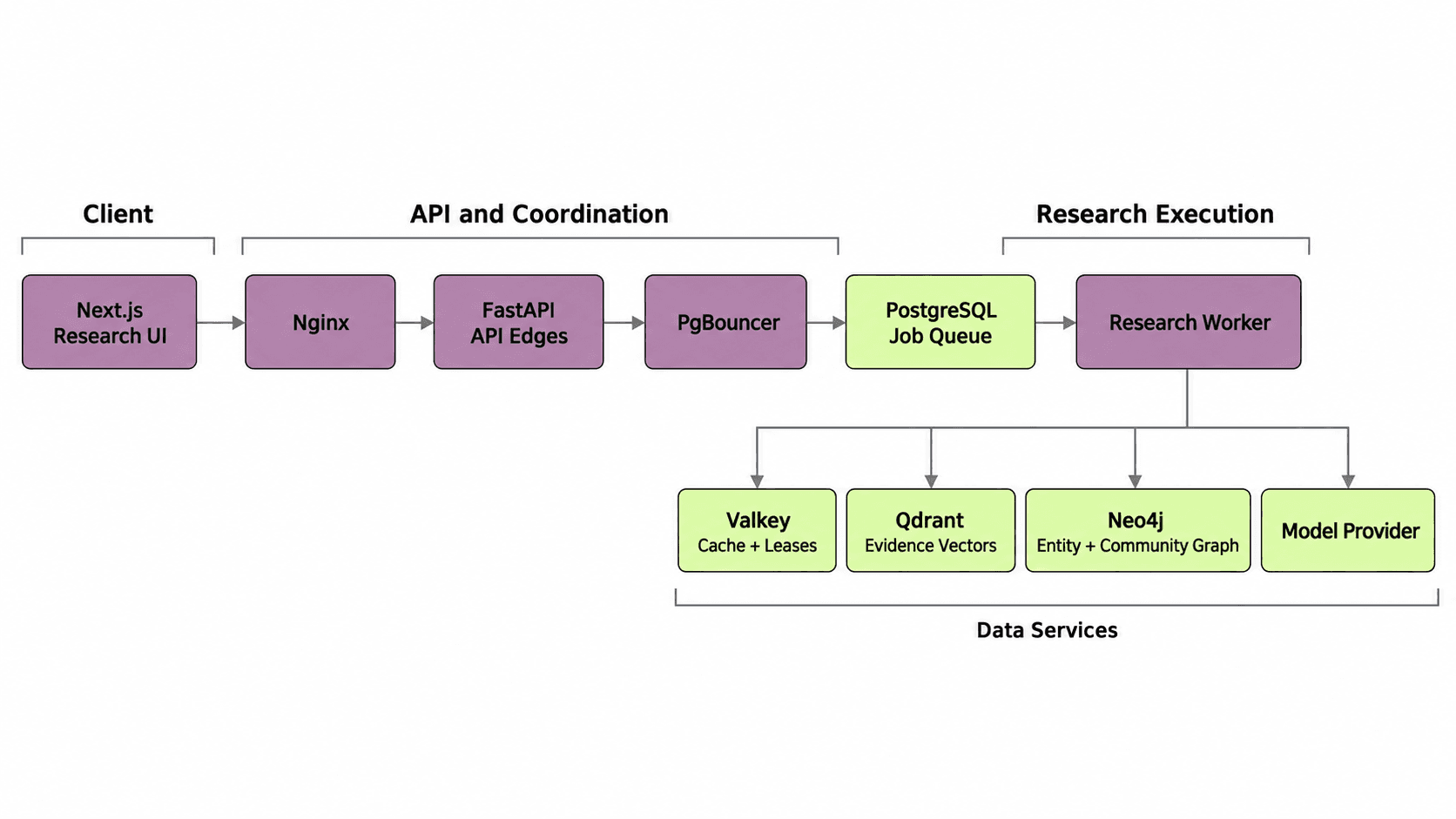
- Next.js application
- Chat, history, source inspection, figure rendering, citations, and progress presentation.
- FastAPI edges
- Request validation, admission control, job creation, status reads, and server-sent event delivery.
- PostgreSQL
- Jobs, events, chat history, checkpoints, idempotency, and worker ownership.
- Research worker
- Query planning, hybrid retrieval, evidence assessment, synthesis, validation, and bounded repair.
- Qdrant and Neo4j
- Vector similarity for evidence and entities; graph topology for relationships and community context.
- Valkey
- Cross-process exact cache, token-owned leases, bounded followers, and shared quota counters.
Corpus pipeline
One canonical evidence model feeds every index
The corpus is built offline and promoted as a versioned release. Text, tables, figures, formulas, entities, and communities keep stable links to their source papers.
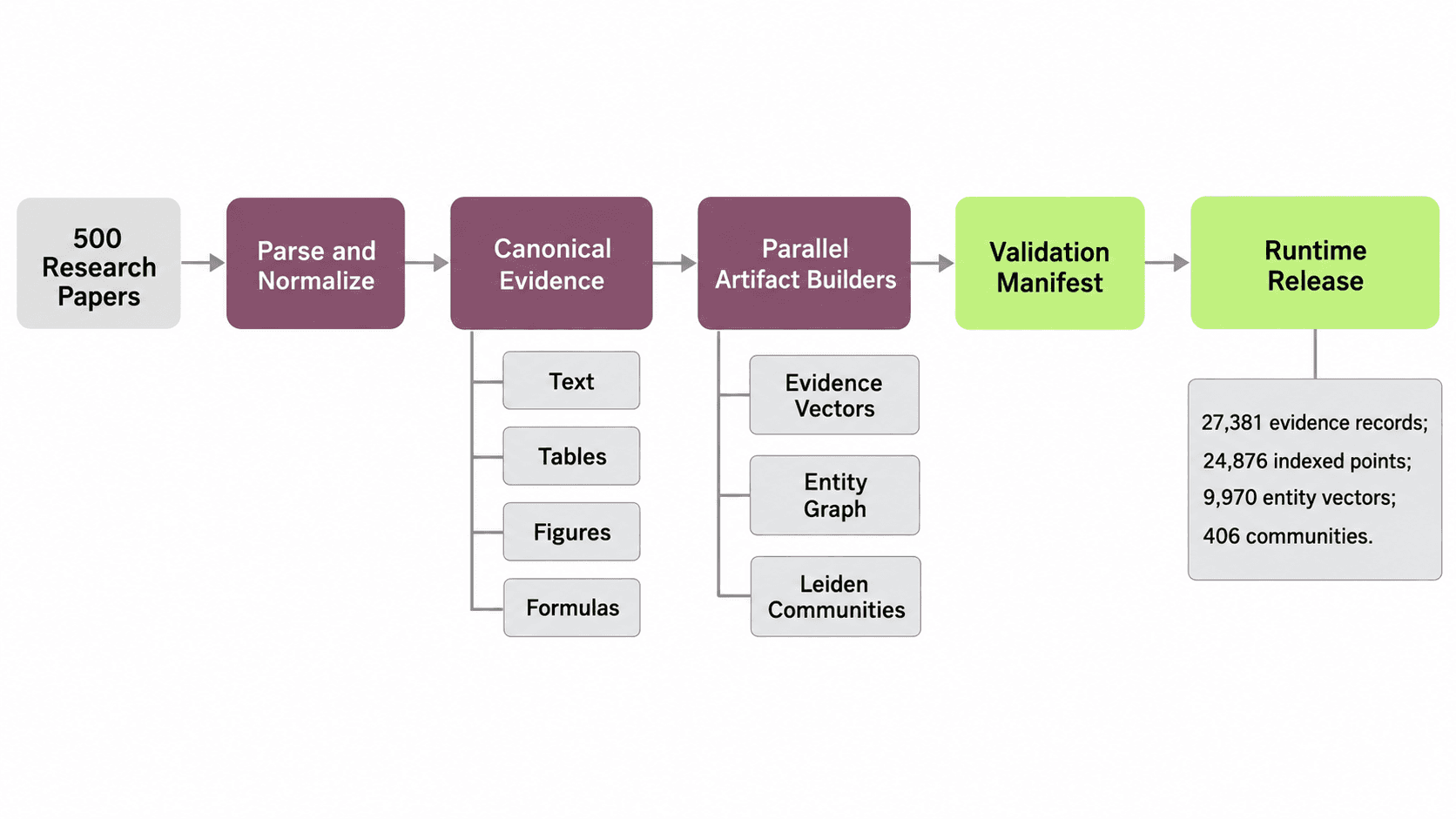
PDF extraction produces canonical records with paper ID, section path, page range, modality, text or caption, and media availability. The downstream builders never invent a second evidence identity; they attach embeddings and graph relationships to those records.
The promoted corpus contains 27,381 canonical evidence records, 24,876 indexed evidence points, 9,970 entity vectors, 12,698 community memberships, 391 hierarchy links, and 94 generated community reports.
Hybrid retrieval
Run complementary searches in parallel, then normalize them
Dense, sparse, entity, and community retrieval solve different recall problems. Their results are merged into one evidence contract before reranking.
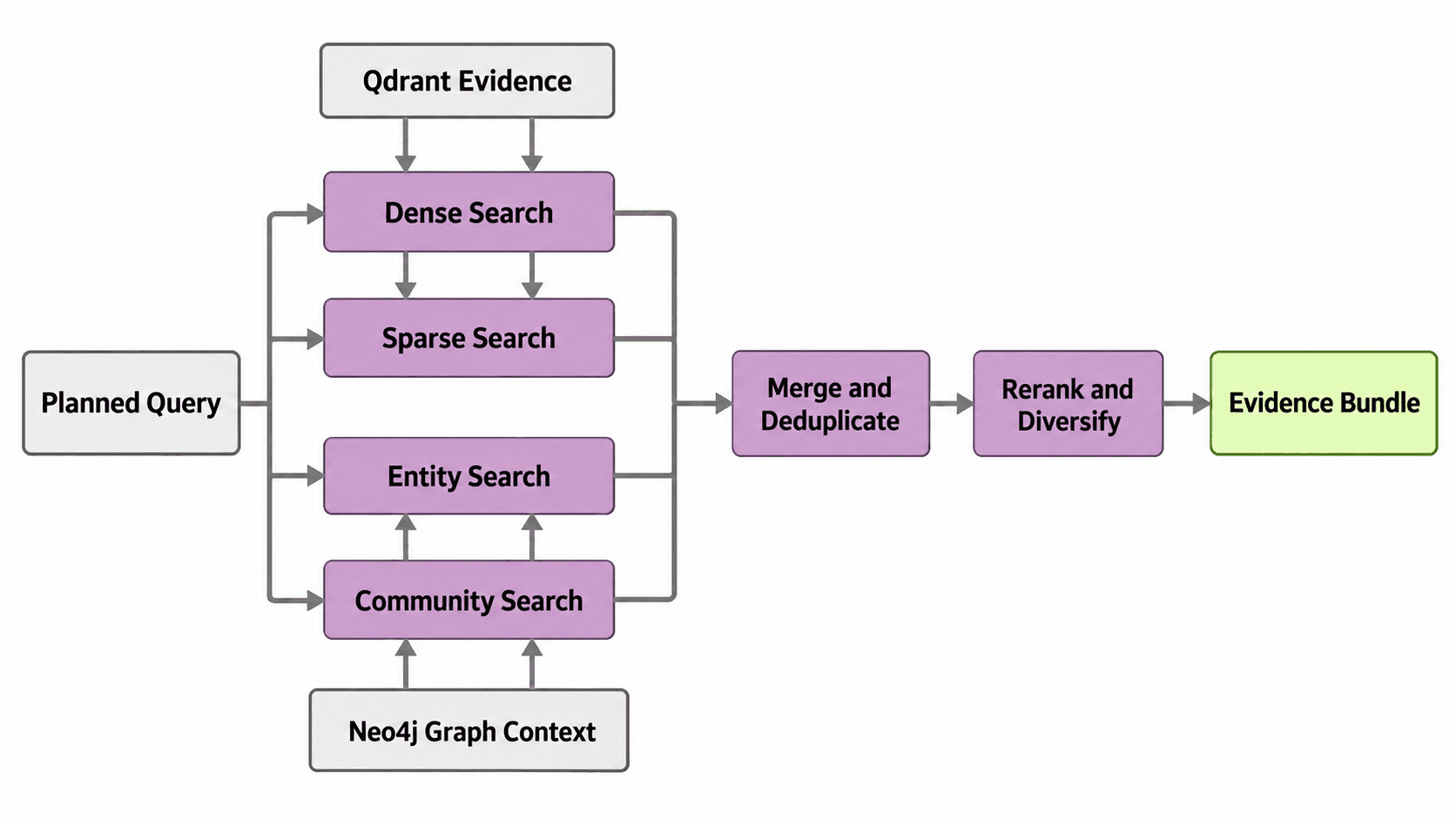
- Dense search
- Finds semantically similar evidence when the wording differs from the question.
- Sparse search
- Preserves exact terminology, paper names, section labels, equations, and distinctive phrases.
- Entity search
- Finds evidence connected to extracted methods, datasets, metrics, and research concepts.
- Community search
- Finds broader topic context assembled from related entities and papers.
- Rerank and diversify
- Removes duplicate evidence, balances papers and modalities, and keeps the final context within budget.
Six logical evidence sources are served by three Qdrant collections: evidence, entity_nodes, and community_nodes. Neo4j stores the relationships needed for graph traversal.
Leiden communities
Turn a paper graph into focused topics and broader themes
Vector search finds nearby passages. Leiden exposes clusters of related research concepts and lets broad questions move from a theme back to specific supporting evidence.
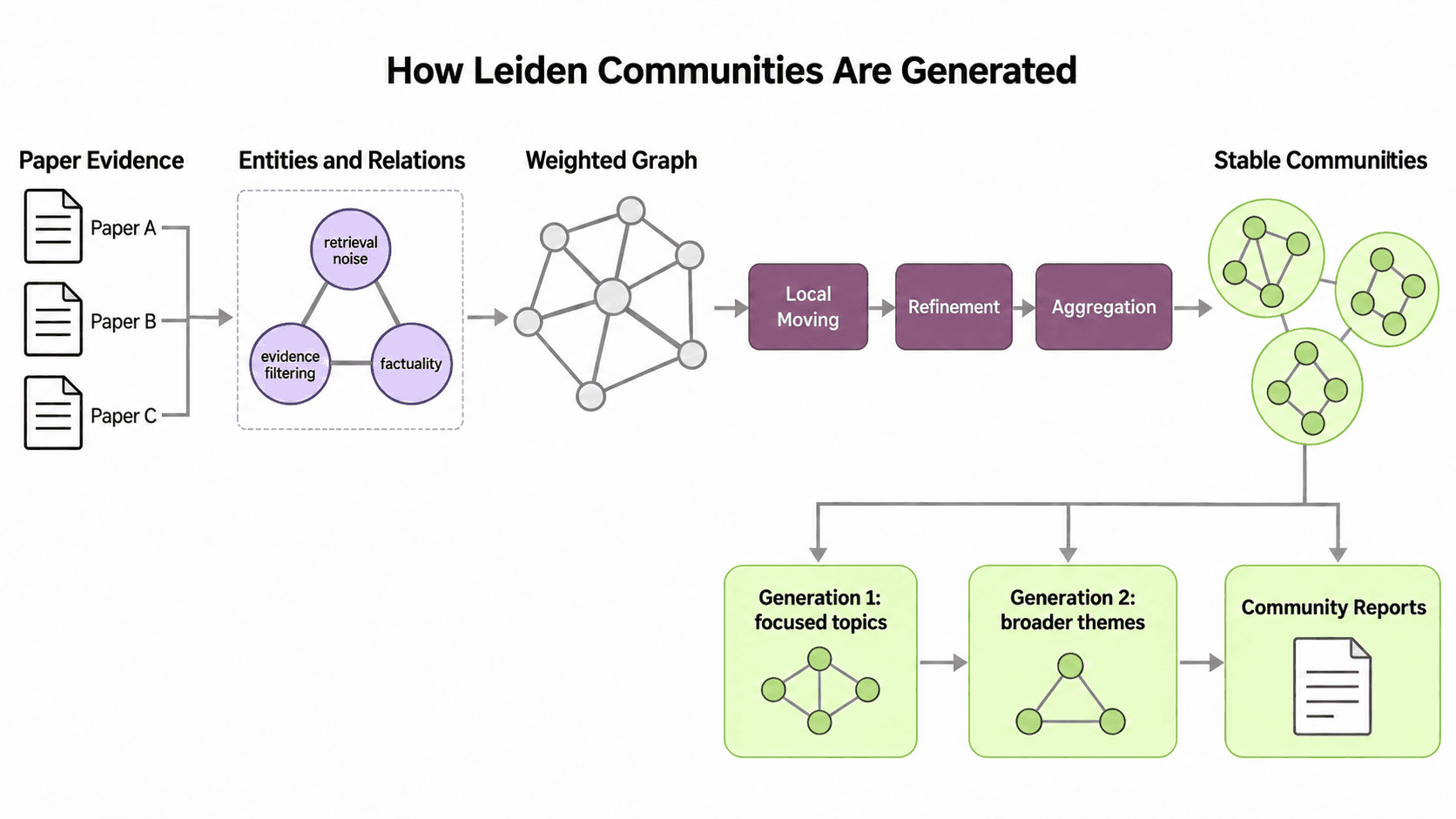
Suppose Paper A studies retrieval noise, Paper B studies evidence filtering, and Paper C studies factuality. Shared entities create weighted graph edges even when the papers do not use the same sentences. Leiden groups densely connected nodes, refines weak groups, and aggregates stable groups into the next level.
The runtime retrieves a community summary for orientation, follows its memberships to relevant entities and papers, and finally cites canonical evidence. Community summaries help discovery; they do not replace source evidence.
Query router
Five predictions run in parallel before a plan is built
The router does not answer the question. It describes the request along five independent dimensions, then a deterministic planner chooses stores, filters, graph depth, and evidence budgets.
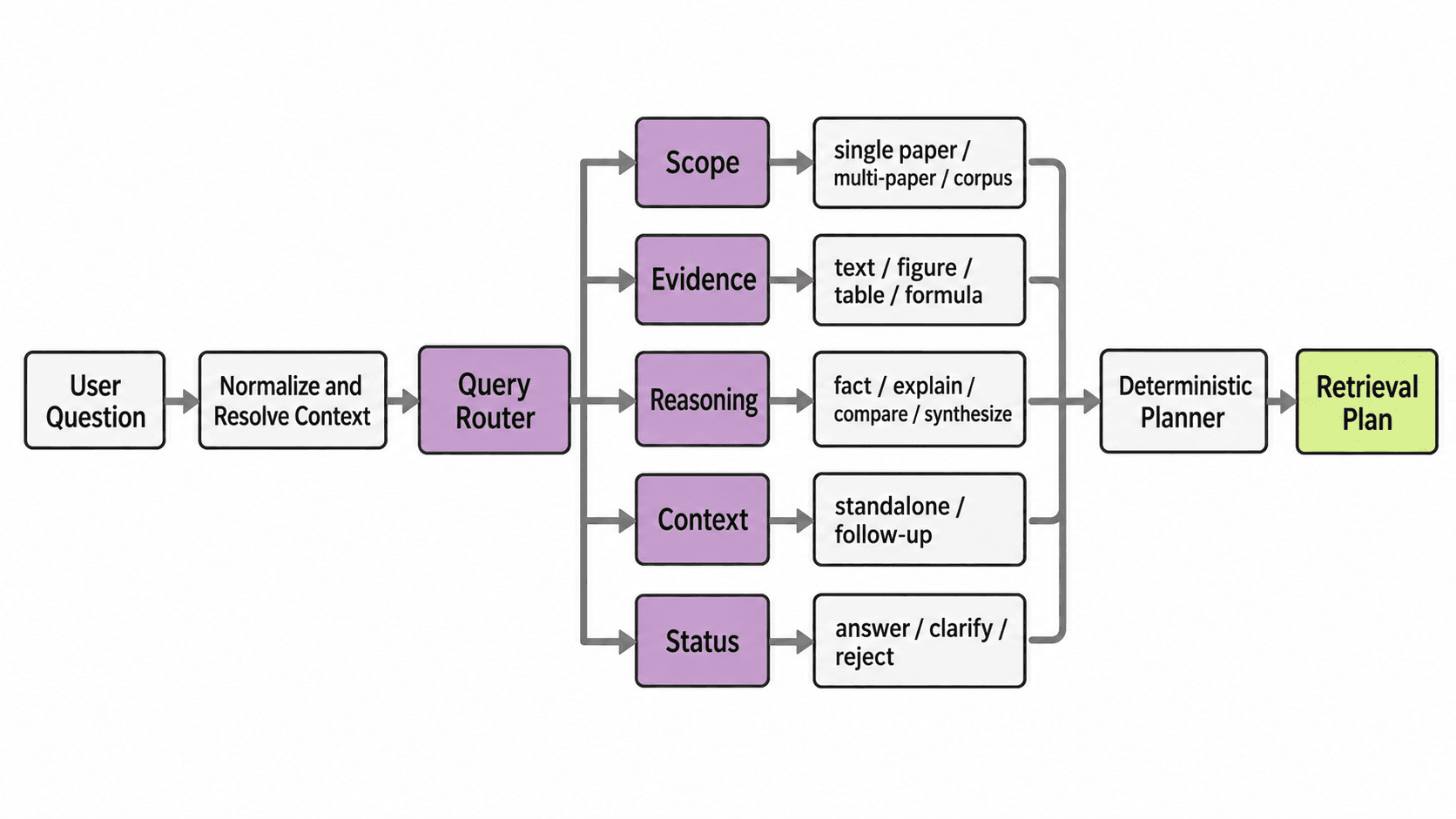
- Scope
- Single paper, multiple named papers, or the full corpus.
- Evidence
- Text, figure, table, formula, or a mixed evidence request.
- Reasoning
- Direct fact, explanation, comparison, or synthesis.
- Context
- Standalone question or a follow-up that must resolve earlier references.
- Status
- Proceed, ask for clarification, reject as out of scope, or stop because a dependency is blocked.
The measured hybrid-router query-status cascade reached approximately 0.9669 macro-F1. That number describes routing classification only; it is not an end-to-end answer-accuracy claim.
Query execution
Two questions, two different retrieval plans
Concrete traces show what the router changes and which data stores the workflow actually touches.
A figure from one paper
“Show me Figure 3 from the ReFilter paper and explain the Context Encoder.”
Router interpretation
- Scope
- Single paper
- Evidence
- Figure + adjacent text
- Reasoning
- Explain
- Context
- Standalone
- Status
- Proceed
Stores touched
- • Qdrant evidence
- • media artifacts
Execution path
- 1Resolve ReFilter to its canonical paper ID.
- 2Filter evidence to that paper and prefer the requested figure record.
- 3Retrieve adjacent section text needed to explain the component.
- 4Verify that the evidence ID has a loadable media payload.
- 5Return the figure, explanation, pages, caption, and source reference together.
Result
A narrow multimodal answer. No graph search or corpus-wide synthesis is needed.
A comparison across papers
“How do ReFilter and other gated RAG methods reduce irrelevant context?”
Router interpretation
- Scope
- Multiple papers
- Evidence
- Text + entity + community
- Reasoning
- Compare
- Context
- Standalone
- Status
- Proceed
Stores touched
- • Qdrant evidence
- • entity_nodes
- • community_nodes
- • Neo4j
Execution path
- 1Resolve the named paper and extract comparison concepts.
- 2Run evidence, entity, and community retrieval in parallel.
- 3Expand only the relevant retrieval-robustness neighborhood in Neo4j.
- 4Rerank with cross-paper diversity so one paper cannot dominate the context.
- 5Synthesize shared mechanisms and differences with paper-specific citations.
Result
A cross-paper comparison whose claims remain tied to distinct source evidence.
Research workflow
Every loop and terminal state is explicit
The LangGraph workflow behaves like a bounded state machine. Evidence can expand once, citation repair can run once, and unsuitable requests exit before expensive generation.
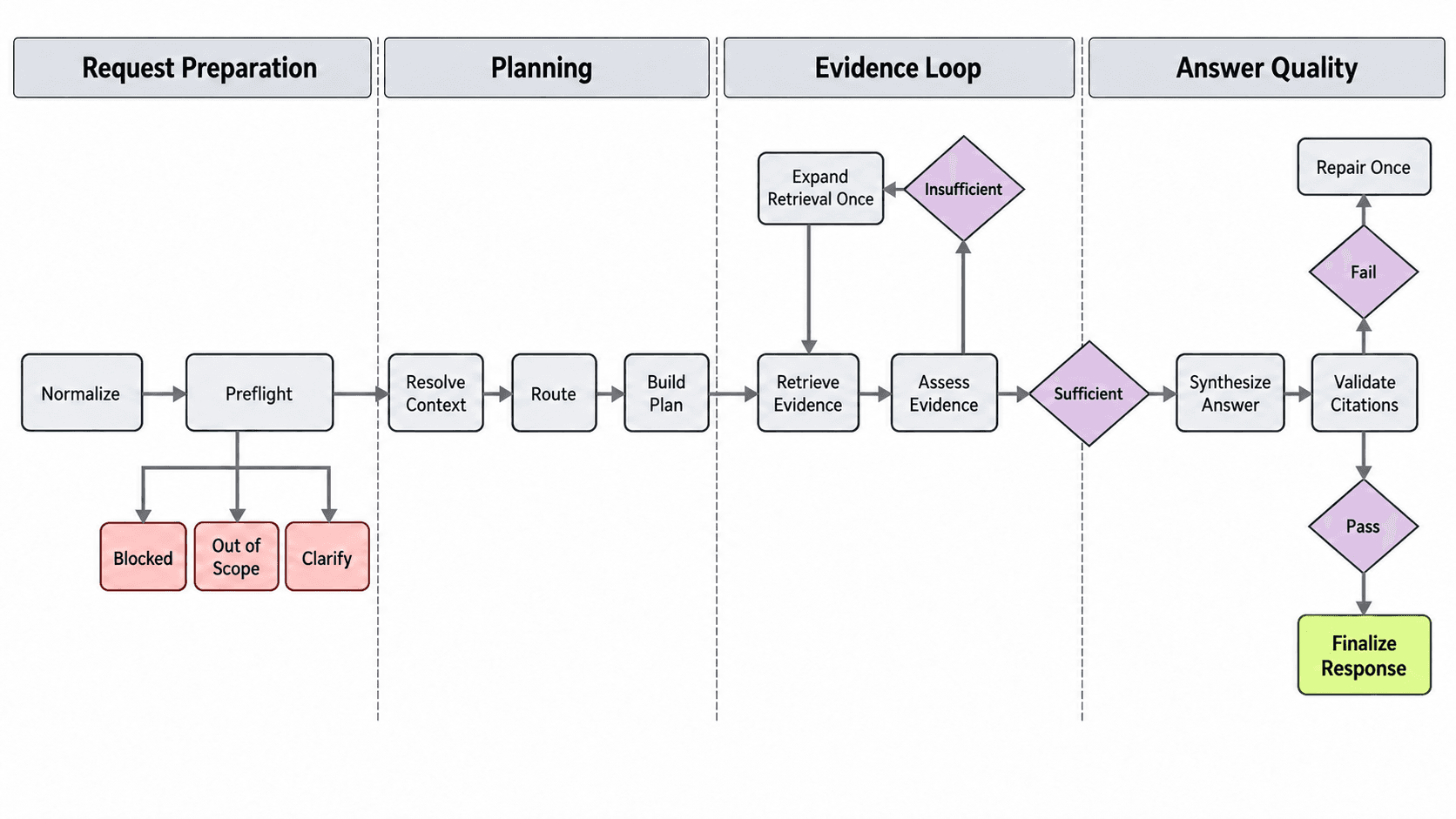
- Request preparation
- Normalize the request, verify dependencies, and resolve follow-up references from bounded conversation history.
- Planning
- Run the router and convert five predictions into stores, filters, candidate budgets, and graph depth.
- Evidence loop
- Retrieve and score evidence. If coverage is weak, expand the plan once and retrieve again; otherwise continue.
- Answer quality
- Synthesize only from the evidence bundle, validate citations and media, repair once if needed, then finalize.
Normal
45 seconds · Focused requests
Research
180 seconds · Cross-paper synthesis
Deep
600 seconds · Wider bounded exploration
Evidence contract
The answer and its sources travel together
Generated prose is not the source of truth. The response carries structured evidence records that the interface can render and the validator can check.
- Canonical identity
- Evidence ID, paper ID, modality, section path, and page range remain stable through retrieval and generation.
- Citation validation
- Every citation must resolve to evidence included in the current answer bundle.
- Visual evidence
- A figure requires both source metadata and a loadable media payload; a caption alone does not imply that the image exists.
- Complete display text
- Search snippets may be shortened, but cited source cards render canonical content instead of a truncated index preview.
This distinction fixed the earlier partial-line problem. Search snippets were being displayed as complete passages, so lines ended mid-sentence. The display path now uses the canonical evidence payload while retrieval continues to use compact index text.
Valkey and scaling
Coordinate duplicate work, then scale the connection layer
Valkey prevents identical requests from starting duplicate research. API replicas scale status reads and event streams, while admission control keeps expensive generation bounded.
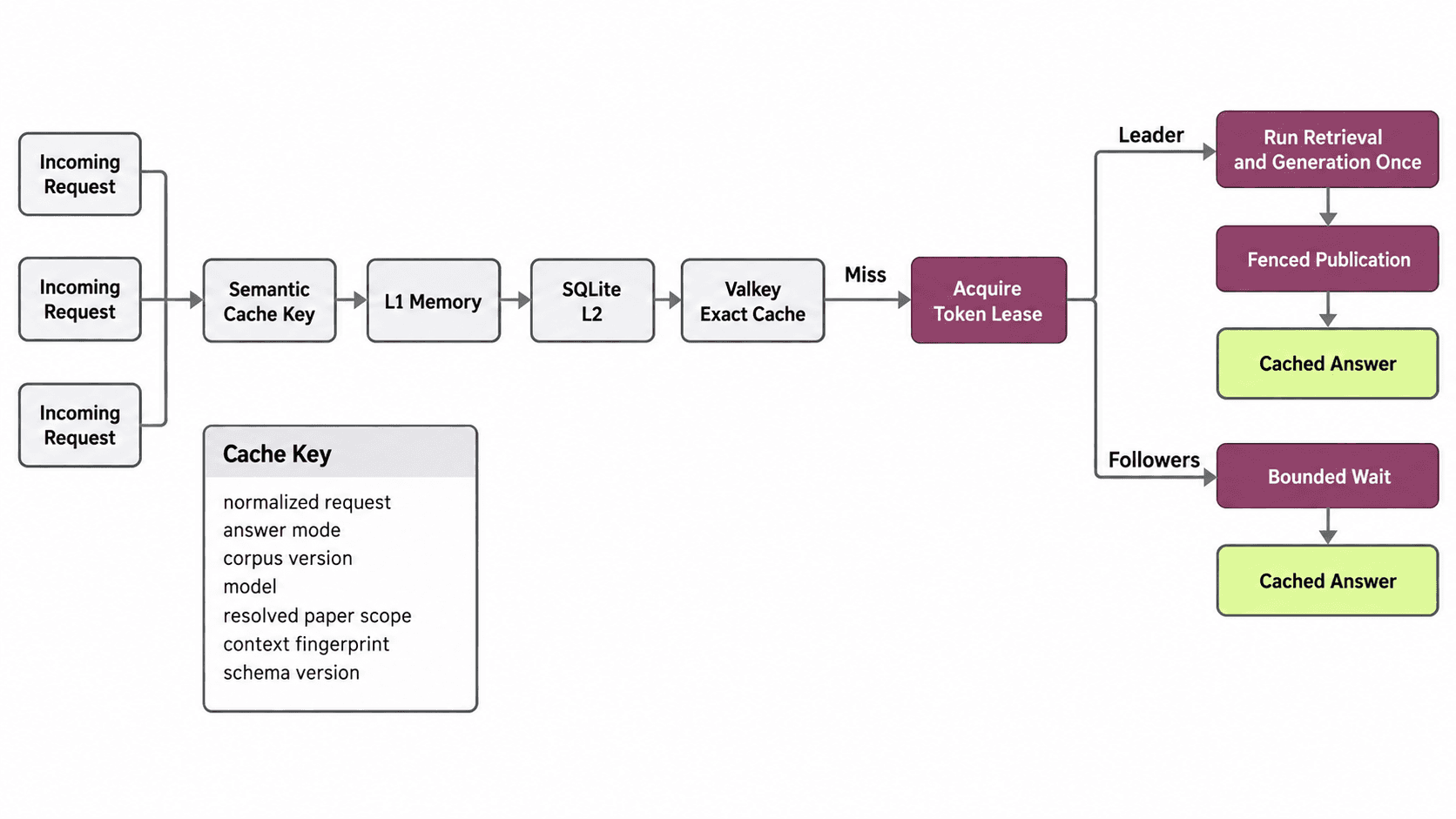
The exact cache identity includes the normalized request, answer mode, corpus version, model, cache epoch, resolved paper scope, bounded context fingerprint, and response schema. Similar wording is not enough when those values differ.
In three separate 100-client bursts, coordinated mode produced one leader and one expensive generation per burst. The measured p95 latencies were 1.917, 1.706, and 1.885 seconds.
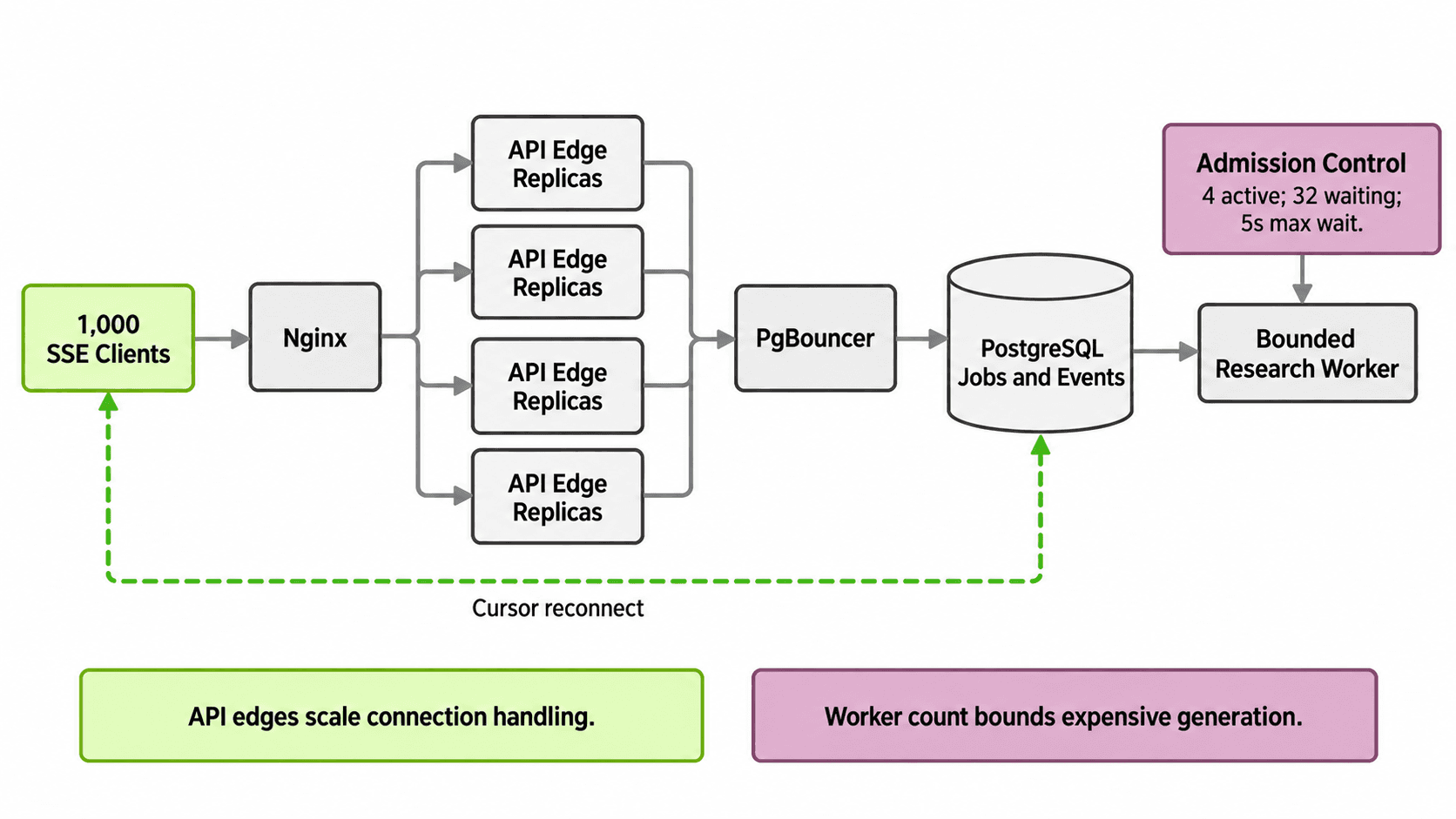
- Admission policy
- Four active expensive requests, 32 FIFO waiters, and a maximum admission wait of five seconds.
- Overload response
- Return 503 with Retry-After when the queue is full; return 409 for overlapping work in the same conversation.
- Connection test
- 500 of 500 and 1,000 of 1,000 local SSE clients connected with no rejected or disconnected clients.
- Reconnect test
- Ten of ten cursor reconnects succeeded at both load levels without duplicate or stale event IDs.
- Claim boundary
- The 1,000-client run tested connection fan-out for 15 seconds with zero research workers and no model-provider attempts. It did not simulate 1,000 simultaneous generations.